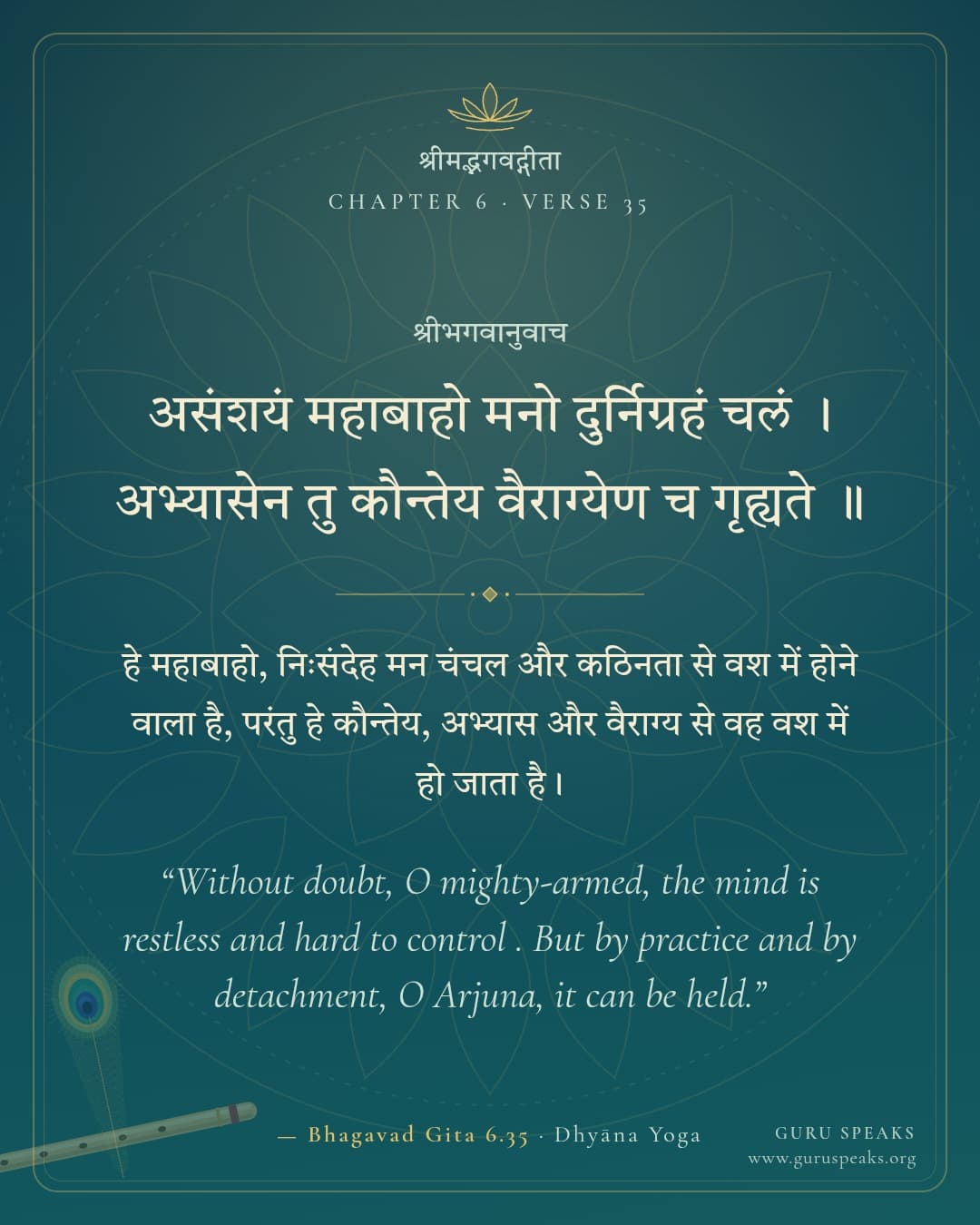
Bhagavad Gita · Chapter 6 · Dhyāna Yoga · Verse 35
The restless mind is tamed by practice and by letting go. — Bhagavad Gita 6.35 meaning in Hindi and English
Sanskrit shloka · संस्कृत श्लोक
श्रीभगवानुवाच
असंशयं महाबाहो मनो दुर्निग्रहं चलं । अभ्यासेन तु कौन्तेय वैराग्येण च गृह्यते ॥
asaṃśayaṃ mahābāho mano durnigrahaṃ calaṃ abhyāsena tu kaunteya vairāgyeṇa ca gṛhyate
Hindi meaning · हिंदी अर्थ
हे महाबाहो, निःसंदेह मन चंचल और कठिनता से वश में होने वाला है, परंतु हे कौन्तेय, अभ्यास और वैराग्य से वह वश में हो जाता है।
English meaning
“Without doubt, O mighty-armed, the mind is restless and hard to control . But by practice and by detachment, O Arjuna, it can be held.”
Reflection for today · आज का चिंतन
Two tools change everything: return again and again, and loosen your grip on what you cannot control. Start small and keep going.
दो साधन सब कुछ बदल देते हैं: बार-बार लौटना, और जो आपके वश में नहीं उस पर पकड़ ढीली करना। छोटी शुरुआत कीजिए और चलते रहिए।
A story for this verse · एक कथा
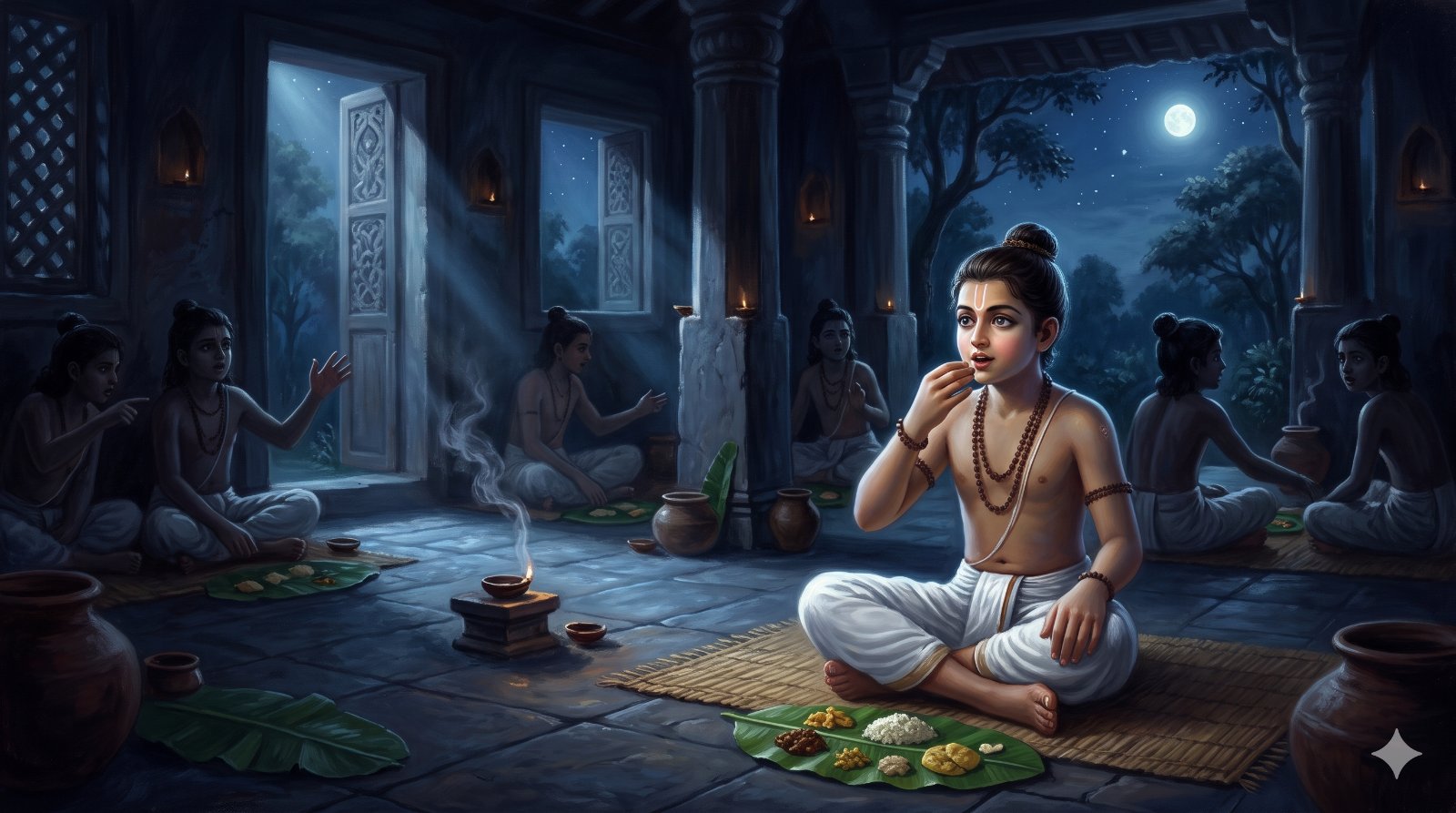
Abhyasa & Vairagya: The True Conquest of the Mind
 In ancient times, when the Pandava and Kaurava princes were receiving their education at the forest hermitage (gurukul) of Guru Dronacharya, their minds, like those of any ordinary young boys, would occasionally wander toward play, chatter, and worldly distractions. One evening, all the young princes sat together having their supper. Suddenly, a strong nocturnal gust blew through the hermitage, extinguishing the earthen oil lamp. Absolute darkness enveloped the pavilion. While the other princes ceased eating in confusion, young Arjuna noticed something extraordinary: even in the pitch-black room, his hand, without hesitation or error, carried each morsel of food straight to his mouth. Arjuna paused, filled with inner wonder. He questioned himself: “My eyes cannot see in this darkness, yet how is it that my hand never wavers and arrives precisely at its destination?” From deep within, the answer resonated: Practice (Abhyasa)! Through years of daily repetition, the act of eating had become so deeply ingrained that even the absence of light could not mislead his hand. Arjuna reasoned that if persistent practice could guide the hand through absolute darkness, then steady, dedicated practice could also master the restless, elusive mind. From that very night, while others slept, Arjuna took up his bow under the quiet moonlight and began practicing archery with tireless perseverance. Some time later, Guru Dronacharya gathered all the princes to test their powers of concentration and inner control. High upon a branch of a towering tree, the master placed a crafted wooden bird.
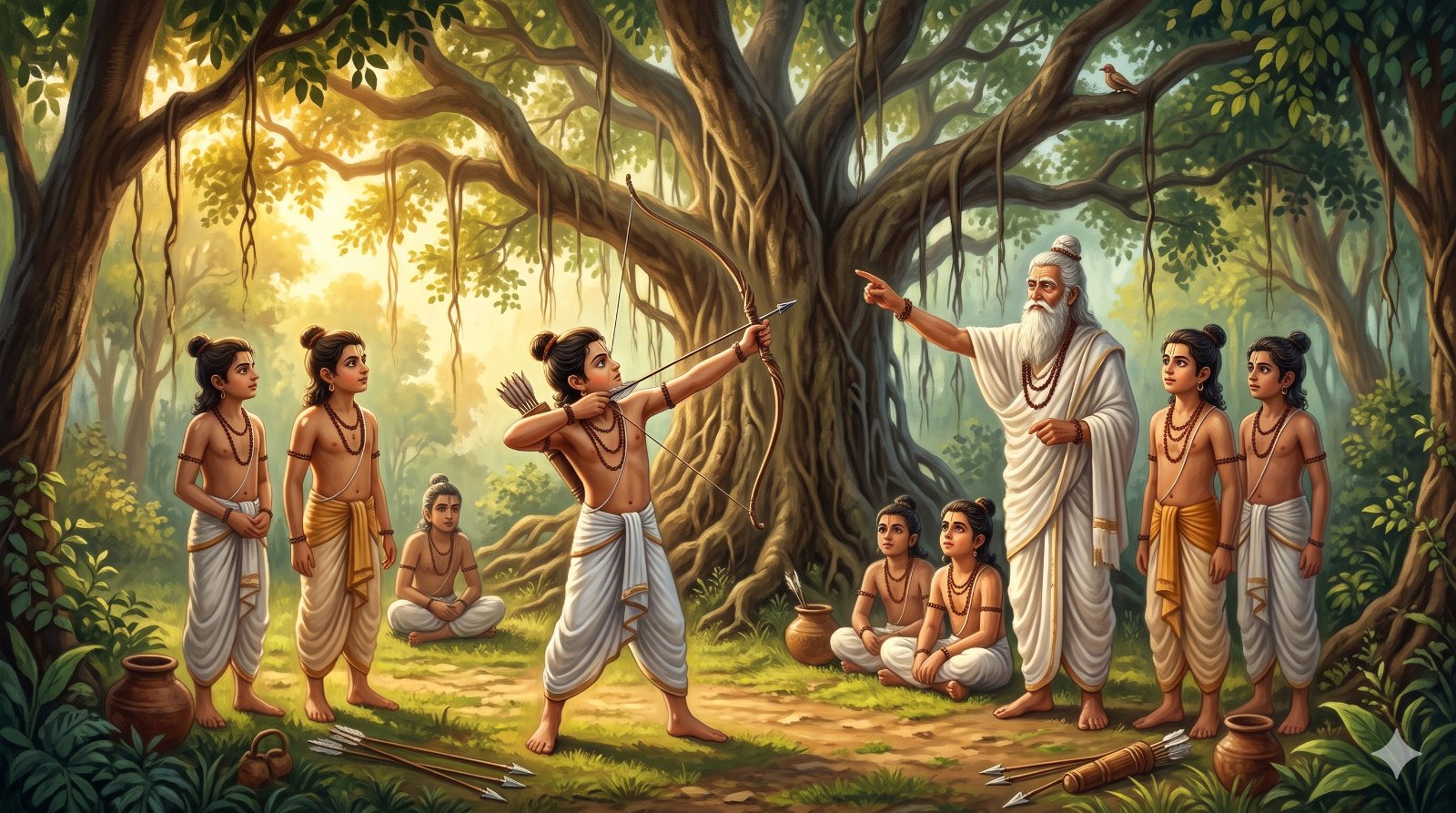 Calling Yudhishthira forward first, the teacher asked, “My child, tell me, what do you behold before you?” Yudhishthira replied, “Revered Guru, I see the grand tree, its leaves, the vast sky, and the bird upon the branch.” Guru Dronacharya asked him to step aside. Duryodhana and the other princes stepped forward one by one, each describing the tree trunk, the swaying foliage, and the forest around them—their awareness dispersed across every peripheral detail. Finally, Arjuna stepped forward and drew his bowstring. Guru Dronacharya asked, “Arjuna, tell me, what do you see?” Arjuna bowed his head and replied, “Guru-deva, I see neither the tree nor its branches, neither the sky nor you, nor even the body of the bird. I see only the black pupil in the eye of that wooden bird.” Guru Dronacharya smiled with profound joy and proclaimed, “This is the true mastery of the mind! When consciousness detaches completely from all peripheral distractions (vairagya) and centers entirely upon its singular aim through unbroken practice (abhyasa), even the most restless mind is conquered.” Moral of the Story (Lesson for Children):
Our mind often scatters toward toys, screens, and games when it is time to study. But just as Arjuna realized that daily practice turns the difficult into the natural, regular study habits and letting go of distractions train our mind to become our best ally, leading to true excellence in everything we pursue.
”Through relentless practice, the impossible becomes effortless; and when the mind detaches from all distractions to center upon its aim, true mastery is attained.”
The lesson
The restless mind is tamed by practice and by letting go.
Story: Panchatantra