Bhagavad Gita · Chapter 2 · Sāṃkhya Yoga · Verse 48
Evenness of mind — that is yoga. — Bhagavad Gita 2.48 meaning in Hindi and English
Sanskrit shloka · संस्कृत श्लोक
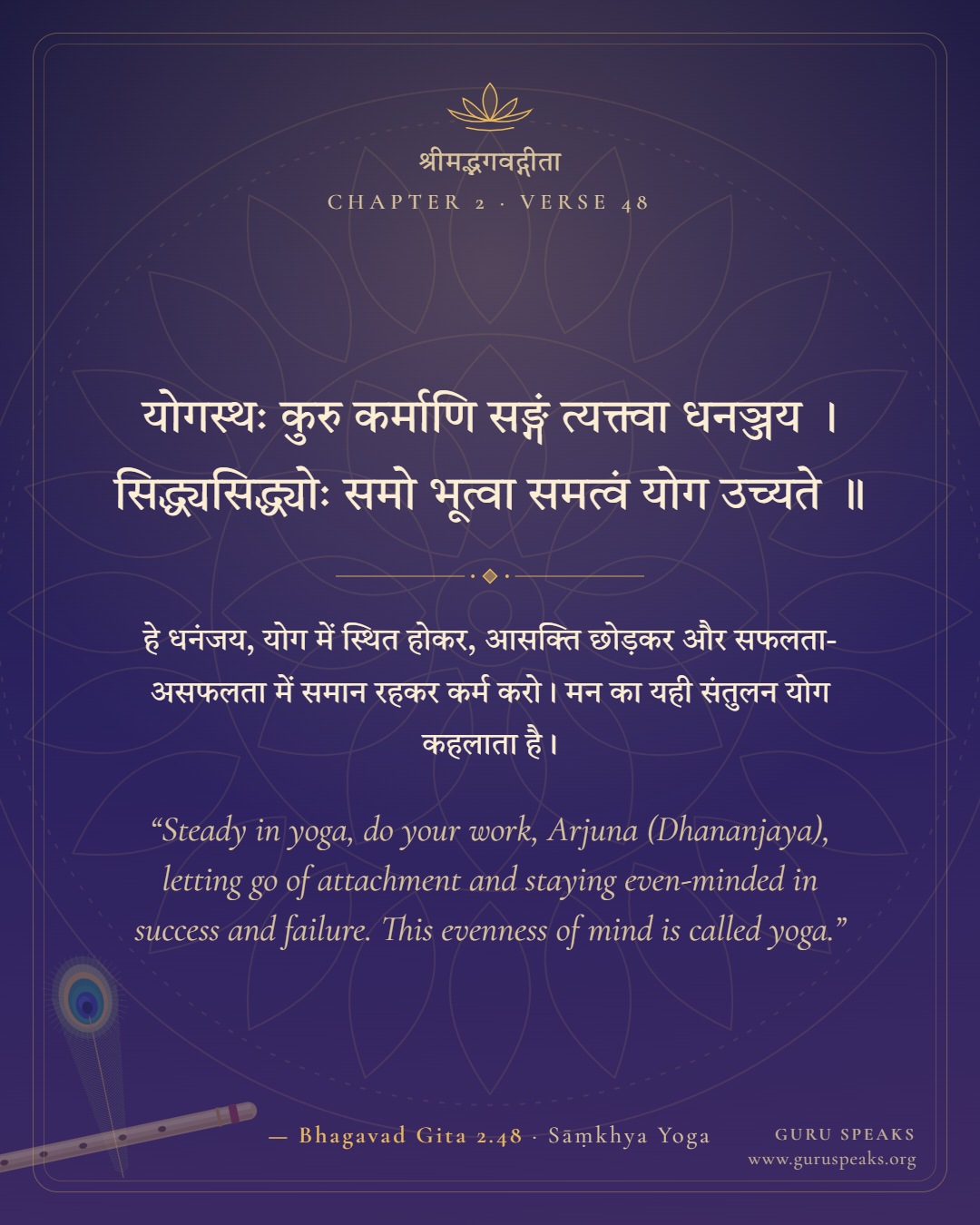
योगस्थः कुरु कर्माणि सङ्गं त्यक्त्वा धनञ्जय । सिद्ध्यसिद्ध्योः समो भूत्वा समत्वं योग उच्यते ॥
yogasthaḥ kuru karmāṇi saṅgaṃ tyaktvā dhanañjaya siddhyasiddhyoḥ samo bhūtvā samatvaṃ yoga ucyate
Hindi meaning · हिंदी अर्थ
हे धनंजय, योग में स्थित होकर, आसक्ति छोड़कर और सफलता-असफलता में समान रहकर कर्म करो। मन का यही संतुलन योग कहलाता है।
English meaning
“Steady in yoga, do your work, Arjuna (Dhananjaya), letting go of attachment and staying even-minded in success and failure. This evenness of mind is called yoga.”
Reflection for today · आज का चिंतन
Yoga is not only a posture on a mat; it is the balance we keep when things go our way and when they don’t. Practise staying steady today, in small wins and small setbacks alike.
योग केवल आसन नहीं, बल्कि हर हाल में मन का संतुलन है। आज छोटी जीत और छोटी हार, दोनों में शांत रहने का अभ्यास कीजिए।
A story for this verse · एक कथा
King Janaka and the Art of Equanimity
In the Mahabharata and ancient Puranic lore, King Janaka of Mithila stands as the foremost exemplar of Samatva Yoga—the yoga of mental equanimity. Although he commanded armies, ruled a prosperous empire, and lived amidst immense worldly splendor, Janaka was revered as Videha—one entirely liberated from bodily ego and possessiveness. He governed with consummate devotion and justice, yet his inner consciousness remained untroubled by the dualities of gain and loss, victory and defeat.
Deep in the adjoining forests, an ascetic hermit heard tales of Janaka’s spiritual stature with profound skepticism. Having spent decades enduring harsh penance, surviving on wild roots, and wearing only a coarse loincloth, the hermit could not comprehend how a crowned ruler adorned in silks and jewels could be a true renunciant. “Authentic detachment belongs only to those who have abandoned the world,” the hermit reasoned. Intending to test the monarch’s supposed wisdom, he traveled to Mithila and sought an audience in the royal court. Janaka received the ascetic with humble reverence, offered him a seat of honor, and engaged him in an earnest dialogue on the nature of the Self.
In the middle of their philosophical exchange, an armed guard burst into the hall, breathless and pale with terror. “Your Majesty!” the soldier cried. “A catastrophic fire has erupted in Mithila! The winds are carrying the flames directly toward the royal quarters!”
Upon hearing this, the ascetic leaped to his feet in sheer panic. That very morning, he had washed his solitary loincloth (kaupina) and set it beside his wooden water pot to dry in the garden. Overcome by frantic dread, the monk shouted, “My cloth will burn! My water pot will be destroyed!” Completely forgetting his spiritual vows, he dashed toward the doorway to rescue his few belongings. Decades of ascetic practice collapsed in a heartbeat over the preservation of a mere rag.
King Janaka, by contrast, remained entirely seated, his breath steady and his mind unperturbed. Not a trace of fear or agitation crossed his face. He neither cursed his destiny nor fell into despair over his vast wealth. Rooted firmly in Yoga (yogastha), he calmly rose and issued decisive, rapid directives to his generals, firefighters, and ministers to secure water reserves, organize containment barriers, and evacuate citizens safely. Janaka acted with sharp intellect and resolute purpose, entirely free of personal distress. Through prompt and disciplined action, the flames were subdued within hours.
When the ascetic returned clutching his cloth, he found Janaka calmly resuming his royal responsibilities. Deeply ashamed, the monk bowed his head and asked, “Your Majesty, your entire kingdom was on the verge of turning to ash, yet your spirit remained as still as a mountain. I, who claimed to renounce the universe, panicked over a strip of cloth. Where does your stillness come from?”
Janaka replied with gentle humility: “Holy one, I do not regard this kingdom as my personal possession; I am merely its custodian. When the fire began, employing every ounce of my skill and energy to extinguish it was my duty. Whether the city survived—success—or burned to embers—failure—my inner Self remains intact. Action is our duty, but anxiety over the outcome is ignorance.”
This inner poise under all circumstances illustrates the core essence of the Gita’s teaching: “Samatvaṁ Yoga Ucyate.” True Yoga does not demand abandoning worldly obligations; it lies in performing one’s duty wholeheartedly while maintaining an unwavering, balanced mind amidst the unpredictable tides of success and failure.
The lesson
Evenness of mind — that is yoga.
Story: Mahabharata tradition